千山獨行BEYOND A THOUSAND MOUNTAINS —
The Poetic Journey of Wen Ren
鑑賞 · 第 1 首 / 共 17

泰岳歌

Song of Mount Tai
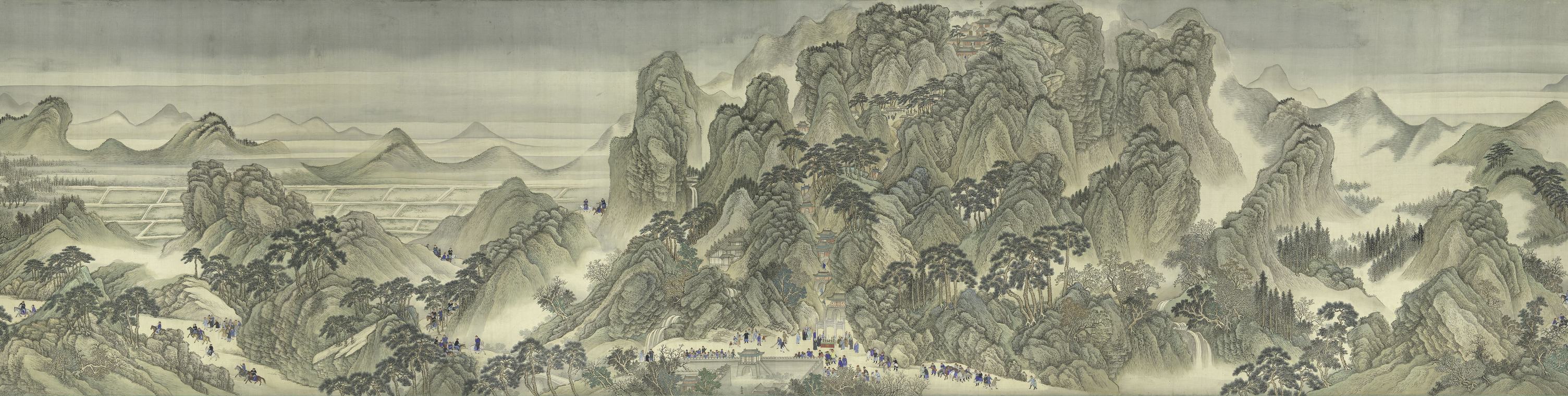
王翬等《康熙南巡圖》第三卷「濟南至泰山」泰山一段 清康熙三十七年(1698) 絹
王翬等《康熙南巡圖》第三卷「濟南至泰山」泰山一段 清康熙三十七年(1698) 絹本設色 全卷 67.9 × 1393.8 cm 美國大都會藝術博物館藏(1979.5a–d) Wang Hui (1632–1717) and assistants, The Kangxi Emperor’s Southern Inspection Tour, Scroll Three: Ji’nan to Mount Tai — the Mount Tai section. Dated 1698. Handscroll, ink and colour on silk, 67.9 × 1393.8 cm. The Metropolitan Museum of Art, New York (1979.5a–d). Public domain (Wikimedia Commons)
小序The Poet’s Preface

戊戌夏,與友人自濟南驅車南行赴泰山,夜過杜甫望岱門,聞松濤陣陣。清晨拾階而上,沿途摩崖林立。友人知書者,遂以千年書史點評百家石刻,嬉笑怒罵盡合章法。及頂,見雲海縱橫,極目開闊,攬山川之壯美,發千古之憂思,嘆時事之多艱,感光陰之難留。身為華夏子孫,長於神州故園齊魯大地,數訪泰嶽而今為之歌,幸哉。

In the summer of the year Wuxu, I set out with friends, driving south from Jinan toward Mount Tai. By night we passed the Gate of Viewing Tai, once praised by Du Fu, where the dark air thundered with the ceaseless roar of pines. At dawn we began the ascent, step by step along the stone stair, the cliffs on either hand adorned with countless inscriptions. One companion, learned in letters, paused at each carving to expound the histories of a thousand years and the writings of many schools, his laughter, censure, and praise all kept in perfect scholarly measure. At the summit the sea of clouds stretched on every side; the eye swept wide across mountain and river, and there rose in me awe at their grandeur, sorrow for the woes of ages, lament for the hardships of our time, and a sense of how little the passing years can be held. Born a son of China, raised on the ancient soil of Qi and Lu, having come to Mount Tai many times, I now raise a song in its honor—fortunate indeed.

原詩The Poem
壯哉盤古歿!頭顱化泰山。拔地擎日月,通靈接九天。勢吞西華壓衡岳,氣奪中嵩秩北恒。東方堪為首,萬物春發生。陽谷入汶陰入濟,水繞環侍幾百峰。岱廟月觀南天杳,玉皇登臨唱其名。摩崖望心驚!筆筆斑駁聞刀刻,步步溯源欲何之?倉頡已去書猶在,卻叫遠古皆漫失。大道曾可知!封禪數千載,富貴冀長安。歷歷梟雄路,血沃幾人全。天聽天視自民始,敬天惜民王者稱。日出岱頂懸丹赤,澤被神州沐蒼生。禮樂何幸興齊魯,齊魯何德擁岱宗。古風遠傳神旨意,四海澄明側耳聽。
作者英譯The Poet’s Own Translation
Magnificent, Pangu’s death: his skull became Mount Tai.Rising from the earth, it shoulders sun and moon, alive to the ninefold sky.Its mass engulfs western Hua and bears down on southern Heng;its spirit outshines central Song and northern Heng.First among the peaks of the East,it summons the ten thousand things into spring.Sunlit valleys flow to the Wen, shaded valleys to the Ji;waters circle in attendance on hundreds of peaks.From the Moon-Viewing Terrace at Dai Temple, the southern sky recedes;I climb Jade Emperor Peak and sing the mountain’s name.The cliff inscriptions stop the heart.Stroke after weathered stroke, I can still hear the chisel;step after step I follow them back—but toward what source?Cangjie is gone. His writing remains,while the deep past dissolves into distance.Was the Great Way ever truly known?For thousands of years emperors came to perform the fengshan rites,hoping wealth and power might secure a long peace.Plainly the conquerors’ road lies before us:blood-fed ground—how many reached the end intact?Heaven hears as the people hear, sees as the people see;only one who reveres Heaven and cherishes the people may be called king.At Tai’s summit the rising sun hangs crimson,its radiance blessing the sacred land and bathing all who live there.How fortunate that ritual and music flowered in Qi and Lu;what virtue gave Qi and Lu the Lord of Mountains?The ancient wind carries the sacred meaning far;the four seas clear, and lean in to listen.
註釋Annotation
  1. 盤古神話中的開天闢地者;詩借其化身寫泰山的來歷。
  2. 五嶽泰山、華山、衡山、嵩山、恆山;「秩」有排列、次序之意。
  3. 汶、濟古代水名;山南為陽,山北為陰。
  4. 摩崖、封禪前者指崖壁石刻;後者指古代帝王的祭天地儀式。
  5. 天聽天視化用《尚書》以民之視聽說天意的表述。
鑑賞Appreciation

詩從盤古化山寫到摩崖文字,再轉向封禪與民生。五言、七言交錯推進,兩處短句讓昂揚的聲勢稍作停頓。山的高大與人的有限彼此映照;結尾的朝陽既照亮眼前山河,也留下對世道的期望。

The poem moves from the mythic birth of Mount Tai to its weathered inscriptions, then to imperial ritual and the lives of ordinary people. Alternating line lengths sustain its momentum, while brief exclamations interrupt the ascent. The mountain’s scale sets human ambition in perspective. At the close, sunrise illuminates both the landscape and a hope for the world beyond it.